


How AI and Autonomous Vehicles Will Transform Car Rentals, Ride Share, Taxis, and the Auto Industry
- 13 minutes ago
- 9 min read
The next major change in transportation will not start with a single product launch. It will arrive through many small shifts: a rental car that predicts when it needs service, a taxi app that sends the right vehicle before demand spikes, a car-share fleet that rebalances itself, and a robotaxi that makes short urban trips feel routine.
AI is already changing how transportation companies price, maintain, route, insure, and manage vehicles. Autonomous vehicles are moving more slowly, but they carry the bigger long-term shock. Together, they could reshape the business model behind car rentals, car-share services, taxis, ride-hailing, and automakers.
The biggest question is not whether the tech works in a lab. It is whether businesses can turn it into services people trust, regulators approve, and operators can run profitably.

Consumer behavior will shift from access to instant mobility
For more than a century, personal car ownership shaped transportation habits in the United States. That model still dominates, especially outside dense cities. But AI-driven mobility services could push more people toward a different mindset: use the best vehicle for each trip instead of owning one vehicle for every trip.
That shift is already visible. Many consumers use a mix of options:
A personal car for daily routines
Ride-hailing for nights out, airport trips, or parking-heavy areas
Car rentals for travel
Car-share for quick errands
Public transit, bikes, and scooters for short local trips
AI makes this mix easier to manage. Apps can predict trip time, suggest the lowest-cost mode, adjust pricing in real time, and match riders with vehicles based on location, party size, luggage, and accessibility needs.
Autonomous vehicles could take this further. If robotaxis become reliable and common, some households may delay buying a second car. City residents may treat autonomous ride-hailing as a utility, like mobile data or home internet. Travelers may land at an airport and choose between a self-driving shuttle, a traditional rental, or an autonomous vehicle rented by the hour.
This does not mean private ownership disappears. Rural areas, families with complex schedules, workers who carry tools, and people who simply prefer control will keep buying cars. The change will be uneven. Dense cities and airport corridors will likely move first. Suburbs may follow through shared autonomous shuttles, school transportation, and senior mobility services.
The key consumer shift is less emotional attachment to a single vehicle and more focus on availability, cost, safety, comfort, and convenience.
Car rental companies will become smarter fleet managers
Car rental companies have always lived and died by fleet use. Too many idle vehicles hurt margins. Too few vehicles lead to long lines, lost bookings, and frustrated customers. AI gives rental operators better tools to manage that balance.
Today, rental companies can use AI and telematics to track vehicle location, mileage, fuel or battery state, tire pressure, driving behavior, and maintenance needs. Instead of waiting for scheduled inspections or customer complaints, a system can flag a vehicle that needs service before it fails.
That matters because downtime is expensive. A car in the shop earns nothing. A car that breaks down during a rental creates towing costs, refunds, and damage to trust.
AI can also improve pricing and placement. Demand changes by airport, season, weather, holidays, local events, and flight delays. A rental branch near a major airport may need more SUVs during family travel periods, while a downtown branch may need smaller cars during weekdays. Better forecasts help companies move cars where they will be used.
Autonomous features may change rentals in stages.
First, rental cars will become more connected and easier to manage. Customers may receive cars through app-based pickup, remote identity checks, and digital keys. Next, vehicles may drive themselves short distances within rental facilities, moving from cleaning bays to charging stations to pickup areas. Later, fully autonomous rentals could deliver themselves to hotels, homes, or airport terminals.
That last step would change the whole experience. The rental counter could become less important. The vehicle itself becomes the service desk.
For rental companies, the opportunity is real, but so is the pressure. Autonomous and electric fleets cost more upfront. Vehicles with advanced sensors may cost more to repair. Companies will need stronger software teams, charging plans, data policies, and partnerships with automakers.
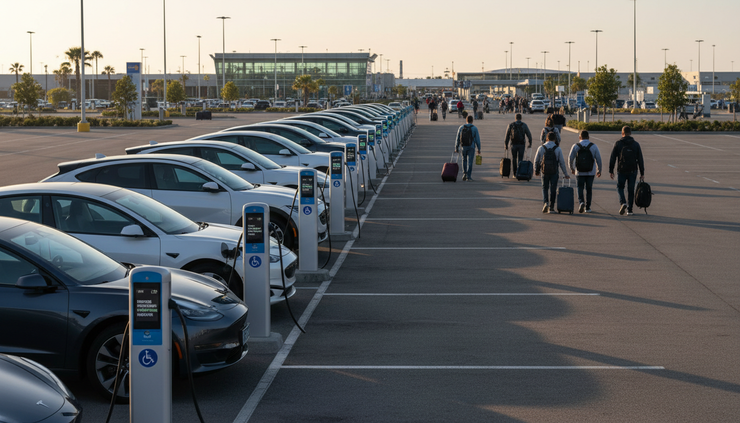
Car-share and ride-share services will compete on convenience
Car-share services such as Zipcar, Turo, and app-based local rental platforms already show how flexible access can compete with ownership. AI can make these services more useful by solving their hardest problems: availability, location, cleanliness, pricing, and trust.
A car-share customer wants the right car nearby, ready now, with no friction. AI can help predict where users will need cars before they book. It can suggest where to park shared vehicles after each trip. It can flag unusual usage, manage digital access, and support faster damage review through photos and vehicle data.
Peer-to-peer car-sharing also benefits from better risk scoring and pricing. A host who rents out a vehicle needs help setting rates, screening bookings, estimating wear, and scheduling maintenance. AI tools can support those decisions, though companies must be careful about fairness, transparency, and privacy.
Ride-share and ride-hailing platforms face a different challenge: matching riders and drivers in real time. Uber and Lyft already use algorithms for routing, pricing, driver positioning, estimated arrival times, and pooled rides. AI can improve those systems by predicting demand around concerts, storms, flight delays, and late-night entertainment districts.
Autonomous vehicles could change ride-hailing more dramatically than any other sector. A robotaxi fleet removes the human driver from the cost structure, at least in theory. That could lower prices, extend service hours, and reduce wait times in high-demand zones.
Yet the “in theory” part matters. A driverless fleet still has costs:
Vehicle purchase or lease payments
Cleaning and charging
Remote support staff
Insurance
Repairs and sensor maintenance
Mapping and software updates
Local permits and safety reporting
The winning companies may not be the ones with the most advanced demo. They may be the ones that can keep vehicles clean, charged, safe, available, and trusted every day.
Taxi operators face a choice between reinvention and decline
The taxi industry has already absorbed one major shock from ride-hailing apps. AI and autonomous vehicles may bring another. But taxis also have advantages that should not be ignored.
Taxi companies often have local operating knowledge, airport access, city permits, commercial insurance experience, and relationships with hotels, hospitals, and public agencies. Those strengths could help them adapt if they invest wisely.
AI can improve traditional taxi dispatch by reducing idle time and sending drivers toward likely demand. It can support better routing, fairer driver schedules, contactless payments, and faster customer service. For accessible transportation, AI can help match riders who need wheelchair-accessible vehicles or extra assistance.
Autonomous taxis, often called robotaxis, are already being tested and operated in limited areas by companies such as Waymo. These services tend to start in mapped zones with favorable weather, clear road designs, and strong local oversight. That limited rollout tells us something important: autonomy will spread by use case, not all at once.
Airports, campuses, entertainment districts, retirement communities, and planned developments may make more sense early on than chaotic roads with snow, construction, and unpredictable pedestrians.
For taxi operators, the biggest risk is waiting too long. If autonomous fleets gain trust in major cities, traditional taxis could lose high-volume routes. The opportunity is to partner, modernize dispatch, specialize in trusted human service, and serve trips where autonomy struggles.
Human drivers may remain important for years in areas that need assistance, judgment, local knowledge, and accountability. The taxi companies that survive may look less like old radio-dispatch fleets and more like mobility service operators with a mix of human-driven and automated vehicles.

Automakers will sell transportation services, not just cars
The automotive industry is already moving toward software-defined vehicles. New cars increasingly receive over-the-air updates, run advanced driver assistance systems, collect performance data, and connect to subscription services. AI sits at the center of that change.
Automakers are using AI in design, manufacturing, quality checks, supply chain planning, driver assistance, and in-car voice systems. Vehicles can now monitor driver attention, help keep lanes, adjust cruise control, park with assistance, and detect possible hazards. These are not the same as full autonomy, but they form the path toward it.
The business model is changing too. Automakers once focused mainly on selling vehicles through dealers. Now they are also exploring subscriptions, fleet services, charging networks, insurance products, and mobility platforms.
This shift affects market dynamics across the full transportation chain.
Sector | What AI changes soon | What autonomy could change later |
Car rental | Pricing, maintenance, fleet placement, digital pickup | Self-delivering vehicles and automated lots |
Car-share | Vehicle availability, access control, damage review | Shared cars that reposition themselves |
Ride-hailing | Matching, routing, demand forecasting, support | Lower-cost robotaxi networks in mapped zones |
Taxis | Dispatch, routing, accessibility matching | Mixed fleets with human-driven and driverless service |
Automakers | Vehicle software, safety features, factory quality | New revenue from autonomous fleets and mobility services |
Automakers may also become suppliers to rental, taxi, and ride-hailing companies in deeper ways. Instead of selling a car and stepping back, they may provide vehicles, software updates, maintenance packages, charging support, and fleet dashboards.
This could blur industry lines. A rental company may act like a tech-enabled logistics firm. A ride-hailing platform may act like a fleet owner. An automaker may act like a transportation provider. A taxi company may manage autonomous vehicles built by someone else.
The future market will reward companies that understand both hardware and service.
The hard problems will decide the pace of change
The promise of AI and autonomy is easy to picture. The hard parts are what will determine the timeline.
Safety comes first. Autonomous vehicles need to handle unusual events, not just normal traffic. Construction zones, emergency vehicles, cyclists, poor lane markings, and bad weather remain difficult. Public trust can rise slowly and fall quickly after a high-profile incident.
Regulation will also shape growth. Cities and states will ask who is responsible when something goes wrong. They will set rules for testing, reporting, insurance, data use, curb access, and passenger safety. Companies that treat regulators as obstacles will struggle. Companies that build trust with local agencies may move faster.
Data privacy is another challenge. AI-powered transportation depends on location data, driving behavior, payment records, vehicle diagnostics, and sometimes camera or sensor data. Businesses need clear rules for what they collect, how long they keep it, and who can use it.
Labor will be one of the most sensitive issues. Taxis, ride-hailing, rentals, repair shops, call centers, and logistics teams all employ people whose jobs may change. Some roles may shrink. Others will grow, including remote fleet support, EV charging operations, sensor repair, cybersecurity, cleaning, customer assistance, and fleet maintenance.
Cybersecurity will matter more as vehicles become connected. A software problem in a single car is frustrating. A software problem across a fleet can stop service, expose data, or create safety risks.
Then there is the economics. Fully autonomous fleets need high vehicle use to justify cost. If cars sit idle, the model weakens. If cleaning, charging, repair, and supervision cost too much, savings from removing the driver may not be enough.
The companies that win will solve boring problems well. They will charge vehicles at the right time, keep interiors clean, help stranded passengers, handle edge cases, and explain what happened when a trip goes wrong.

Businesses should prepare for a mixed future
AI and autonomous vehicles will not replace every transportation model at once. The more likely future is mixed.
Some people will own cars. Some will subscribe. Some will rent by the day. Some will share by the hour. Some will hail a human driver. Others will ride in autonomous vehicles within approved zones. Many will switch among all of these without thinking much about the category.
For businesses, that means strategy should focus less on defending old labels and more on solving mobility needs.
Car rental companies can build stronger data systems, prepare facilities for EVs, test digital handoff, and explore delivery-based rentals. Car-share companies can use AI to improve trust, placement, and vehicle care. Taxi operators can upgrade dispatch, specialize in service quality, and seek partnerships before they are forced into them. Ride-hailing platforms can ease into autonomy while improving the experience for riders and drivers now. Automakers can design vehicles for fleet life, easier cleaning, lower repair costs, and software updates.
The main opportunity is not simply driverless cars. It is a transportation system that uses vehicles more efficiently, gives consumers more choice, and helps businesses match supply with real demand.
The main risk is assuming the future arrives evenly. It will not. It will arrive city by city, route by route, fleet by fleet.
The companies that adapt early will not chase every new feature. They will ask practical questions: Where do customers wait too long? Where do vehicles sit unused? Which trips cost too much to serve? Which tasks can AI improve now? Which autonomous use cases are safe, legal, and useful enough to test?
The future of transportation will belong to businesses that combine smart software with real-world discipline. AI can predict demand, guide maintenance, and improve service. Autonomous vehicles can change the cost and shape of mobility. But trust, safety, and execution will decide who turns the technology into a service people use every day.
Comments